
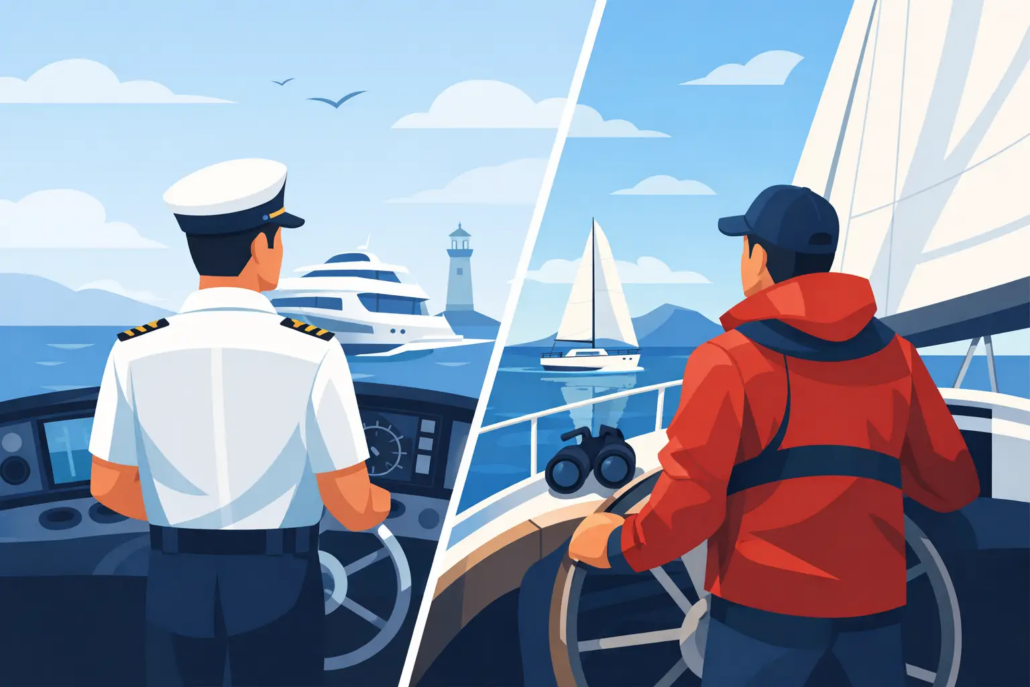
Boatmaster versus RYA Skipper Licensing: Which Fits?
A skipper taking guests from a Caribbean marina has a different responsibility from an owner sailing a charter catamaran between Antigua and Barbuda. That is the practical question behind Boatmaster versus RYA skipper licensing. Both routes build real competence on the water, but they were designed for different operating environments, different authorities, and often different career goals.
Choosing the right qualification is not about collecting the most certificates. It is about matching your license, practical experience, and local legal authority to the vessel you intend to command. For some sailors, an RYA practical course is the strongest first step toward confident cruising. For a professional running passenger vessels, water taxis, workboats, or local charters, a Caribbean Boatmaster credential may be the essential requirement.
Boatmaster versus RYA skipper licensing: the core difference
The simplest distinction is this: an RYA skipper certificate demonstrates a recognized level of recreational and, in some cases, commercially endorsed yachting competence. A Boatmaster license is generally a statutory or regional professional license that authorizes a person to operate specific vessels in defined waters, subject to the rules of the issuing maritime authority.
RYA qualifications are structured around progressive sail and power training. A sailor may begin with Competent Crew or Start Yachting, progress through Day Skipper and Coastal Skipper, then work toward Yachtmaster. The courses and examinations assess seamanship: passage planning, navigation, collision regulations, pilotage, boat handling, safety, watchkeeping, and command decision-making.
Boatmaster training is more directly connected to commercial vessel operation. The syllabus and assessment can cover local navigation, operating limits, passenger safety, vessel stability, emergency response, maritime law, radio procedures, and the practical demands of carrying people or cargo. Requirements vary by jurisdiction and license category. A Boatmaster qualification is not one universal international document with identical privileges everywhere.
That difference matters. An RYA certificate can be highly respected by charter companies, employers, insurers, and marinas worldwide. But respect is not the same as legal authority. If local law requires a Boatmaster license for a particular commercial role, an RYA certificate alone may not meet that requirement.
When an RYA skipper qualification is the better route
RYA training is a natural fit for sailors who want a clear, internationally recognized route through practical yachting. It is especially valuable if your goal is to charter a sailing yacht, own and cruise your own boat, build confidence as a watch leader, or create a foundation for professional yacht work.
A Day Skipper qualification, for example, gives developing sailors a practical benchmark for skippering a small vessel in familiar waters by day. It is not a promise that every charter company or country will accept it automatically, but it is widely understood as evidence of trained, supervised practical ability. For many Caribbean charter guests, it is a sensible next step after gaining basic crewing experience.
The RYA route also rewards broader cruising ambitions. Someone planning passages across the Leeward Islands, the British Virgin Islands, the Mediterranean, or farther offshore benefits from a syllabus built around transferable seamanship. Weather, tidal calculations, close-quarters handling, and route planning remain relevant long after the course ends.
For professionals, the path can continue toward Yachtmaster certification and the appropriate commercial endorsement. This is a meaningful career route for crew who want to work aboard yachts, progress into command, or demonstrate a recognized standard to employers. The commercial endorsement process typically brings additional requirements, such as medical fitness, sea survival training, professional practices, and other supporting certificates.
Still, RYA certification should not be treated as a universal captain’s license. Its privileges depend on the certificate held, vessel type and size, commercial endorsement status, flag-state rules, insurer requirements, and the country where the vessel operates. The stronger your ambition, the more important it becomes to check those details before taking a job or accepting a charter booking.
When a Boatmaster license is the right answer
Boatmaster licensing is often the more direct route for people whose work is tied to local commercial operations. Think of a captain running a sightseeing boat from a Caribbean harbor, a crew member progressing into a water-taxi command role, or a tourism business that needs qualified personnel to operate passenger vessels safely and legally.
In these settings, local knowledge is not a minor advantage. It is central to safe command. A skipper must understand the harbor approach, reef systems, traffic patterns, weather behavior, mooring fields, port procedures, and emergency resources specific to the operating area. Boatmaster programs are commonly designed to assess that context alongside hands-on vessel handling.
The license may also define important operational boundaries: the class of vessel, whether passengers may be carried, the distance from shore, daylight or nighttime operation, and the waters in which the holder may work. These limits are not a weakness. They are how a licensing system ties authority to demonstrated competence and a controlled operating environment.
For marine businesses, this can make Boatmaster training a practical investment in compliance and capability. Tourism operators, watersports teams, transport providers, charter businesses, and workboat companies need more than talented boat handlers. They need crew members who understand their legal duties, passenger care, emergency procedures, and the limits of their authority.
The career question: local operator or mobile yacht professional?
Your intended career is one of the best ways to choose between Boatmaster and RYA skipper licensing.
If you plan to work primarily in one Caribbean jurisdiction on locally registered commercial vessels, investigate the relevant Boatmaster route first. It may be the qualification an employer, port authority, or regulator expects to see. Add RYA training where it strengthens your practical skill set or supports longer-term progression, but do not assume it replaces the local license.
If you want to move between yacht programs, work internationally, or build a career on private and charter yachts, the RYA progression is often more portable. Yacht crew recruiters and operators commonly recognize the pathway, particularly when paired with sea time, safety training, radio certification, and a commercial endorsement where required.
Many serious professionals benefit from both. A Boatmaster license can support legal commercial operations in a home region, while RYA training develops the passage-planning, command, and yacht-specific skills that open wider opportunities. The combination is particularly useful for Caribbean captains who work locally during the season but want the flexibility to join yacht or delivery work elsewhere.
Do not confuse a course certificate with permission to operate
This is where skippers can make costly assumptions. Completing a capable course proves training and assessment. It does not automatically grant every privilege needed to operate a vessel commercially, carry paying passengers, charter internationally, or satisfy an insurer.
Before choosing a program, establish four facts: where the vessel is registered, where it will operate, whether it will be used commercially, and what type and size of vessel you will command. Then confirm the requirements with the relevant maritime authority, vessel owner, charter company, or employer. Ask specifically about passenger carriage, commercial endorsements, safety certificates, radio qualifications, medical requirements, and local operating limits.
This check is particularly important in the Caribbean, where vessels, flags, charter arrangements, and territorial waters can change quickly over a short passage. A qualification that is suitable for private sailing in one location may not meet the regulatory standard for a paid charter or passenger operation in another.
Building the right training pathway
For a new recreational sailor, start with practical instruction that puts you on the helm, in the chartwork, and into the daily rhythm of a crew. From there, Day Skipper theory and practical training can create a credible base for chartering and independent coastal cruising.
For an aspiring professional, build the safety and operational foundation early. Sea survival, first aid, fire safety, security awareness, VHF radio competence, logged sea time, and strong boat handling all matter alongside the headline license. If your work will be commercial and local, identify the Boatmaster category first so your time and training lead toward the correct authority.
For established crew or captains, assess the gap rather than repeating familiar material. You may need a local commercial license to take command in Antigua, an RYA qualification to demonstrate yacht-specific capability, or a higher level of navigation and offshore experience to progress into larger responsibilities. Ondeck Sailing can help align Caribbean Boatmaster, RYA practical, theory, and safety training with the role you are preparing to take on.
The best license is the one that lets you operate confidently, lawfully, and within your proven limits. Choose the route that serves your next real command, then keep building the experience that makes the certificate meaningful when the wind rises and people are relying on you.

