
STCW Personal Survival Versus Fire Prevention
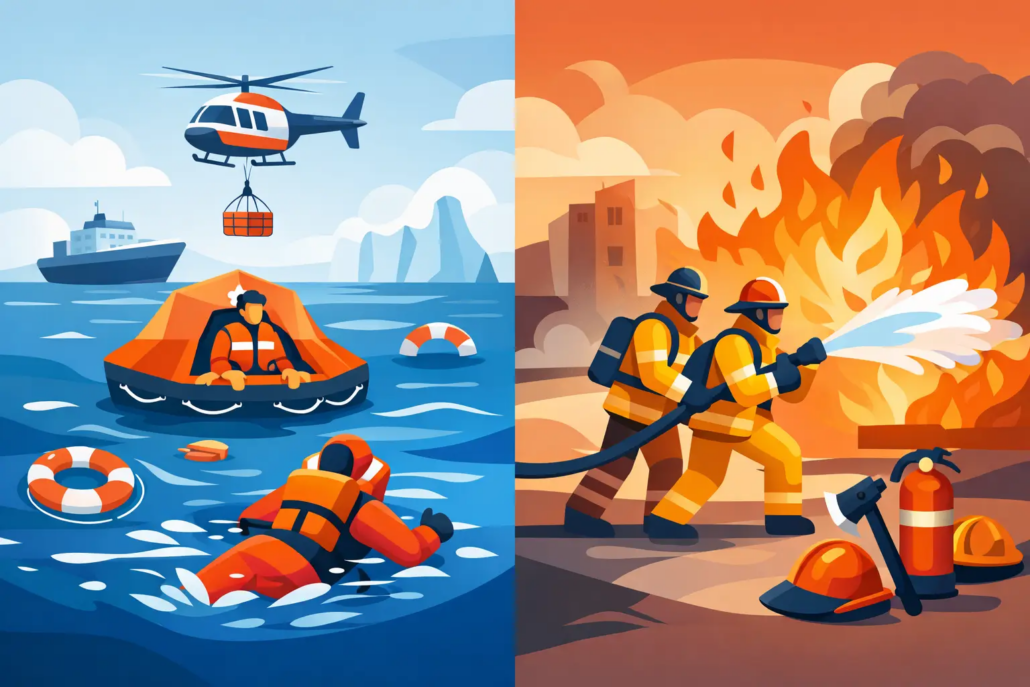
A life raft in open water and a fire inside a yacht are both emergencies, but they demand very different decisions in the first critical minutes. That is the practical distinction behind STCW personal survival versus fire prevention training. One prepares you to abandon ship and survive until rescue. The other prepares you to prevent, identify, and fight a fire before abandoning ship becomes necessary.
For new deckhands, charter crew, skippers, and marine-industry teams, the names can sound like two versions of the same safety course. They are not. Both are core parts of STCW Basic Safety Training, and both build the judgment expected of competent crew. The right approach is usually not to choose one over the other, but to understand what each module covers and why employers, flag administrations, and commercial operations commonly require the complete set.
STCW Personal Survival Versus Fire Prevention: The Core Difference
STCW Personal Survival Techniques, often called PST, is about staying alive when leaving the vessel is the only safe option. It covers the actions that reduce panic, protect energy, and improve your chances of being found after an abandonment. Training is practical: participants learn how to enter the water safely, use a lifejacket correctly, work as a group in the water, board survival craft, and manage the early stages of survival.
STCW Fire Prevention and Fire Fighting, commonly shortened to FPFF, focuses on stopping an onboard fire from escalating. It begins well before anyone picks up a hose. Crew learn the conditions that create fire, common causes in accommodation spaces, galleys, engine rooms, and electrical systems, plus the principles behind detection, alarms, containment, and extinguishing media. The practical element develops safe response habits with portable extinguishers, breathing apparatus, fire hoses, and team communication in controlled training scenarios.
Put simply, personal survival answers, “What do I do once I am in the water or survival craft?” Fire prevention answers, “What can I do to stop this emergency from forcing us into the water?”
What You Learn in Personal Survival Techniques
Personal survival training is not a swimming lesson, although comfort in the water is helpful. Its purpose is to make a crew member useful and composed after an emergency signal has sounded. A candidate should understand the survival equipment carried aboard, the role of muster stations, and the sequence of actions that follows an order to abandon ship.
The water-based exercises show why technique matters. Jumping from height without injury, entering the water when wearing a lifejacket, and avoiding unnecessary exertion all require practiced movement. Candidates also learn how to adopt heat-conserving positions, form groups to improve visibility and preserve warmth, right an inverted life raft where applicable, and enter a survival craft safely.
In the Caribbean, warm water can create a misleading sense of security. Exposure may be less immediate than in northern waters, but sun, dehydration, fatigue, sea state, current, injury, and separation from the group remain serious risks. Professional crew need skills that work in the conditions they may encounter, whether that is a calm Antigua anchorage, a night passage, or a rougher offshore delivery.
PST also reinforces the value of preparation. A life raft is not a solution by itself. Crew must know where it is stowed, how it is launched, what equipment it contains, and how to organize people around it. That knowledge protects charter guests as much as it protects the crew.
What You Learn in Fire Prevention and Fire Fighting
A fire at sea develops fast and leaves little margin for hesitation. On a yacht or commercial vessel, smoke can spread through confined spaces, escape routes can be limited, and engine-room systems can make the situation more complex. Fire Prevention and Fire Fighting training teaches crew to recognize the problem early and respond as a team.
The prevention side is as valuable as the firefighting side. Candidates study the fire triangle – heat, fuel, and oxygen – and how removing one element can control a fire. They learn why poor housekeeping, overloaded electrical circuits, fuel leaks, hot surfaces, battery charging, galley operations, and improper storage of flammable materials create onboard hazards.
They also learn that the wrong extinguishing method can make an incident worse. Water may be appropriate for some ordinary combustible materials but dangerous around energized electrical equipment or burning oil. Foam, dry powder, carbon dioxide, fire blankets, fixed systems, and boundary cooling each have specific uses and limitations. Training gives crew a framework for selecting an appropriate response, rather than reacting on instinct.
The practical exercises matter because fire response is physical and procedural. A crew member may need to raise the alarm, report the location and type of fire, isolate fuel or ventilation, close doors to contain smoke, don protective equipment, and operate extinguishing gear under direction. Clear command structure is essential. A determined individual acting alone can become another casualty; a coordinated team has a far better chance of controlling the incident.
Why Commercial Crew Usually Need Both
For most professional pathways, PST and FPFF are not competing qualifications. They are complementary modules within the STCW basic safety foundation, alongside first aid and personal safety and social responsibilities. Exact requirements can depend on your role, vessel type, flag state, employer policy, and the waters in which you work, but commercial yacht and maritime employers commonly expect valid STCW Basic Safety certification.
If you are pursuing a first deckhand role, working aboard a charter yacht, supporting watersports operations, or moving into commercial skippering, completing only one module may leave a gap in your safety credentials. It can also leave a genuine gap in your readiness. A crew member who can operate a fire extinguisher but does not understand life raft procedures is not fully prepared for a major incident. The reverse is equally true.
For recreational sailors, the legal requirement may be different. A private owner operating locally may not need STCW certification in the same way as paid crew. Yet the skills are still highly relevant for anyone taking responsibility for guests, family, or a vessel offshore. The decision comes down to your sailing ambitions, not just the minimum rulebook.
Choosing the Right Course Path
If your objective is commercial employment, plan for the full STCW Basic Safety package from the start. It creates a clear, recognized foundation for applications to yachts, charter companies, marine tourism operators, and support vessels. It also avoids the inconvenience of taking one module now and returning later for the rest when a job opportunity appears.
If you are a charter skipper or experienced recreational sailor, consider where you want your qualifications to take you. A move from private sailing into paid charter work, delivery work, or a leadership role on a larger vessel changes the standard expected of you. Formal safety training supports that progression and adds useful confidence to your practical seamanship.
For businesses, a standard course may be the right baseline, but the most effective training often reflects real operating risks. A day-charter crew, resort watersports team, ferry operator, and superyacht department face different equipment layouts, passenger profiles, and emergency procedures. Bespoke training can reinforce the STCW principles against the scenarios your team is most likely to face.
Certification, Refreshers, and Real Competence
A certificate confirms that you completed training to the required standard. It should not be treated as a substitute for onboard familiarization. When joining a vessel, crew still need to locate alarms, extinguishers, fire blankets, emergency shutoffs, lifejackets, life rafts, muster lists, and escape routes. Every vessel has its own layout, equipment, and emergency plan.
Refresher expectations can also vary. Some administrations and employers require evidence that certain STCW competencies have been maintained or refreshed within a specified period, particularly for seagoing service and regulated roles. Check the current requirements of your intended flag, employer, or certificate of competency before booking, especially if you are returning to the industry after time ashore.
The strongest crews do not wait for a renewal date to revisit safety. They talk through emergency roles before departure, keep equipment checks disciplined, and treat drills as an opportunity to identify small problems before they become serious ones.
Training in Antigua gives these lessons an immediate context: active charter traffic, serious yachting, open-water passages, and a maritime culture where practical competence carries weight. At Ondeck Sailing, STCW training can sit alongside sailing progression, helping candidates build credentials without losing sight of the real purpose behind them – protecting people when conditions change.
The best time to decide who will raise the alarm, fight the fire, launch the raft, and account for every person aboard is while the sea is calm and the vessel is secure. Build those skills before your next role or passage, then keep practicing them until the right response feels automatic.

