
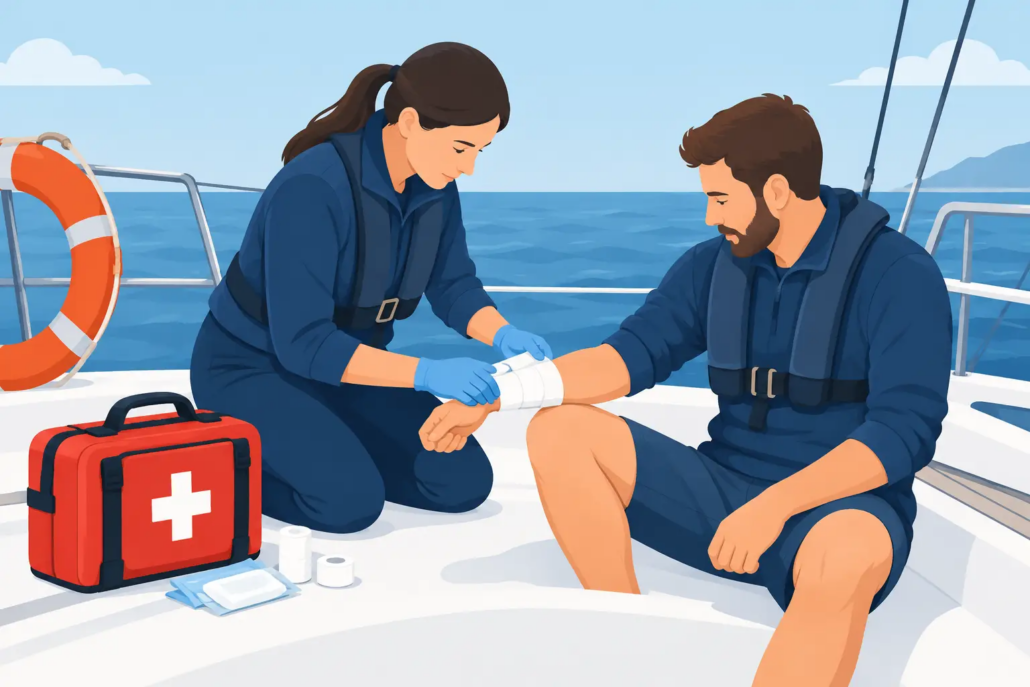
A Guide to Maritime First Aid for Sailors
A deep cut from a galley knife, a suspected fracture after a rough jibe, or a crew member fading in the Caribbean heat can change the mood aboard in seconds. This guide to maritime first aid is built around the practical reality of being offshore: help may be available, but it is rarely immediate. Good decisions in the first minutes protect the casualty, the crew, and the vessel.
Maritime first aid is not simply shore-based first aid delivered on a boat. Movement, weather, limited space, saltwater, distance from emergency services, and the need to keep the vessel safely under command all affect how an incident is managed. Whether you sail for adventure, charter professionally, race a regatta, or work in tourism and watersports, preparation and calm assessment are core seamanship skills.
First priorities: make the vessel and casualty safe
The temptation is to rush directly to the injured person. Before treatment begins, pause long enough to control the immediate danger. A casualty cannot be properly cared for if the boat is broaching, a boom is uncontrolled, an engine is still running near the water, or another crew member is at risk.
Assign roles early. One person takes command of the boat, another stays with the casualty, and a third prepares communications and gathers the first aid kit. On a small crew, those roles may overlap, but naming the priority prevents everyone from focusing on the injury while the vessel drifts toward a reef or shipping lane.
Start with a simple primary assessment. Check whether the casualty is responsive, whether their airway is open, whether they are breathing normally, and whether there is severe bleeding. If they are unconscious but breathing, place them in a safe position where practical, protect them from further movement, and monitor them continuously. If they are not breathing normally, begin CPR if it is safe to do so and arrange urgent assistance.
Severe external bleeding needs immediate direct pressure with a sterile dressing or clean absorbent material. Do not repeatedly lift the dressing to check the wound. Add more padding over the top if blood soaks through, maintain pressure, and seek medical advice or evacuation as soon as possible.
The maritime first aid assessment: look beyond the obvious
A visible injury may not be the most serious problem. A person who has fallen, been struck by gear, or recovered from the water may have a head, neck, spinal, chest, or internal injury even when they are awake and talking.
Use a systematic secondary assessment once the immediate life threats are addressed. Ask what happened, where it hurts, whether there was any loss of consciousness, and whether they have medical conditions, allergies, or regular medications. Observe their skin color, breathing effort, pulse, level of alertness, and ability to move normally. Reassess frequently. A casualty whose condition is deteriorating needs a different response from one who is stable and improving.
Keep clear notes. Record the time of the incident, symptoms, treatment given, medications administered, vital signs where training and equipment allow, and any communications with medical professionals. These details support a radio or satellite medical consultation and become valuable when the casualty reaches shore.
Avoid giving medication casually. The right pain relief can make a long passage safer and more tolerable, but the wrong drug, dose, or combination can cause harm or mask significant symptoms. Follow your vessel’s medical procedures, check allergies and contraindications, and obtain remote medical guidance when there is uncertainty.
Common emergencies aboard and the practical response
Heat illness, dehydration, and sun exposure
The warm trade winds can make people underestimate how much fluid they are losing. Long watches, alcohol, seasickness, heavy foul-weather gear, and active sail handling all increase the risk. Early signs of heat exhaustion include thirst, headache, fatigue, dizziness, nausea, cramping, and heavy sweating.
Move the person into shade, reduce exertion, cool them with wet cloths or airflow, and offer small, regular amounts of fluid if they are awake and able to swallow. A person who becomes confused, collapses, has a seizure, or develops hot skin with altered behavior may have heat stroke. This is a medical emergency requiring rapid cooling and urgent outside assistance.
Seasickness and dehydration
Seasickness can become more than discomfort when it causes repeated vomiting, exhaustion, and inability to hydrate. Keep the casualty in fresh air where possible, warm and dry, and safely positioned away from hazards. Small sips of water or oral rehydration fluids are often more manageable than large drinks.
Persistent vomiting, blood in vomit, severe abdominal pain, confusion, or very little urine needs medical advice. Do not assume every sick crew member is simply seasick, particularly after a head strike or exposure to fumes.
Cuts, punctures, and marine wounds
Saltwater does not sterilize a wound. Cuts from fishing gear, coral, shells, galley equipment, and deck hardware should be cleaned thoroughly with clean fresh water, then covered with an appropriate sterile dressing. Control bleeding first, but once it is controlled, careful cleaning matters.
Punctures, deep wounds, bites, wounds contaminated with marine material, and injuries involving embedded objects deserve a low threshold for professional medical assessment. Do not remove a large embedded object if doing so could increase bleeding. Stabilize it, dress around it, and arrange help.
Head injuries and suspected fractures
A head injury should be treated seriously after a fall, boom strike, collision, or man overboard recovery. Warning signs include worsening headache, repeated vomiting, confusion, drowsiness, unequal pupils, seizure, weakness, fluid from the nose or ears, or any loss of consciousness. Keep the person under close observation and seek urgent medical advice.
For a suspected fracture, prevent unnecessary movement, support the injured area in the position found, and check circulation, sensation, and movement beyond the injury before and after applying support. A limb that is pale, cold, numb, severely deformed, or increasingly painful may indicate a time-critical problem. Do not attempt to straighten it.
Man overboard and immersion
Recovery from the water is only the beginning. A casualty may be injured, exhausted, hypothermic, or affected by inhaled water even in warm conditions. Handle them gently, remove wet clothing when safe, insulate them from wind and cold surfaces, and monitor breathing and consciousness.
Anyone who has inhaled water, is coughing persistently, has breathing difficulty, or becomes unusually tired after rescue needs medical assessment. Continue observation because respiratory symptoms can develop after the initial incident.
Build a first aid kit for your passage, not a marina berth
A small day-sailing kit will not meet the needs of an overnight delivery, offshore race, charter program, or remote island cruise. Your kit should reflect the vessel’s operating area, crew size, trip duration, likely hazards, and the medical training aboard. Check it before departure rather than discovering expired supplies in an emergency.
A well-organized maritime kit normally includes:
- Sterile dressings, gauze, adhesive bandages, wound-closure strips, tape, gloves, trauma shears, and cleaning supplies.
- Materials for serious bleeding, including pressure dressings and equipment appropriate to the training level of the crew.
- Thermal protection, instant cold packs, triangular bandages, splinting materials, eye-wash supplies, and a CPR barrier device.
- Clearly labeled medications carried under the vessel’s procedures, along with an inventory, expiry-date record, casualty forms, and waterproof notepad.
Store the kit where it can be reached quickly, protect it from heat and moisture, and make sure every regular crew member knows its location. A medical kit sealed in a locker beneath bags, sails, and provisions is not ready for use.
Communications are part of treatment
Calling for advice early is not a sign of weak seamanship. It is good risk management. Depending on your location and vessel equipment, this may involve VHF, mobile phone, satellite communications, coast guard contact, or a dedicated medical advisory service.
When requesting help, give the vessel name, position, nature of the emergency, number of people aboard, casualty age and relevant medical history, symptoms, treatment already given, and the condition of the boat. Be ready to describe weather, sea state, nearest safe harbor, and your estimated arrival time. Keep the radio clear and appoint one person to log instructions accurately.
The decision to divert depends on the casualty’s condition, the stability of their symptoms, distance to care, weather, vessel capability, and the advice received. A stable minor wound may be managed until landfall. Chest pain, severe breathing difficulty, altered consciousness, uncontrolled bleeding, suspected stroke, serious trauma, or anaphylaxis demand a much faster escalation.
Training turns equipment into capability
A first aid certificate is valuable, but skill fades without practice. Crew should rehearse where the kit is stored, how to make an urgency or distress call, how to recover a casualty safely, and how to manage the boat while someone is being treated. Scenario practice is especially useful because it exposes the operational problem: one person may need to steer, communicate, and support a casualty in a moving cockpit.
For professional crew, charter operators, watersports teams, and commercial skippers, training should match the operating environment and regulatory duties. Recognized maritime safety training builds a stronger foundation than generic assumptions about what might be needed at sea. Ondeck Sailing’s professional training pathways are designed to support that progression alongside practical seamanship in Caribbean conditions.
The best moment to prepare for a medical emergency is before the anchor is up and the shoreline is behind you. Check the kit, brief the crew, refresh your skills, and make a clear plan for calling for help. That preparation gives everyone aboard more confidence to enjoy the passage, the race, or the next quiet anchorage with the right margin of safety.

