
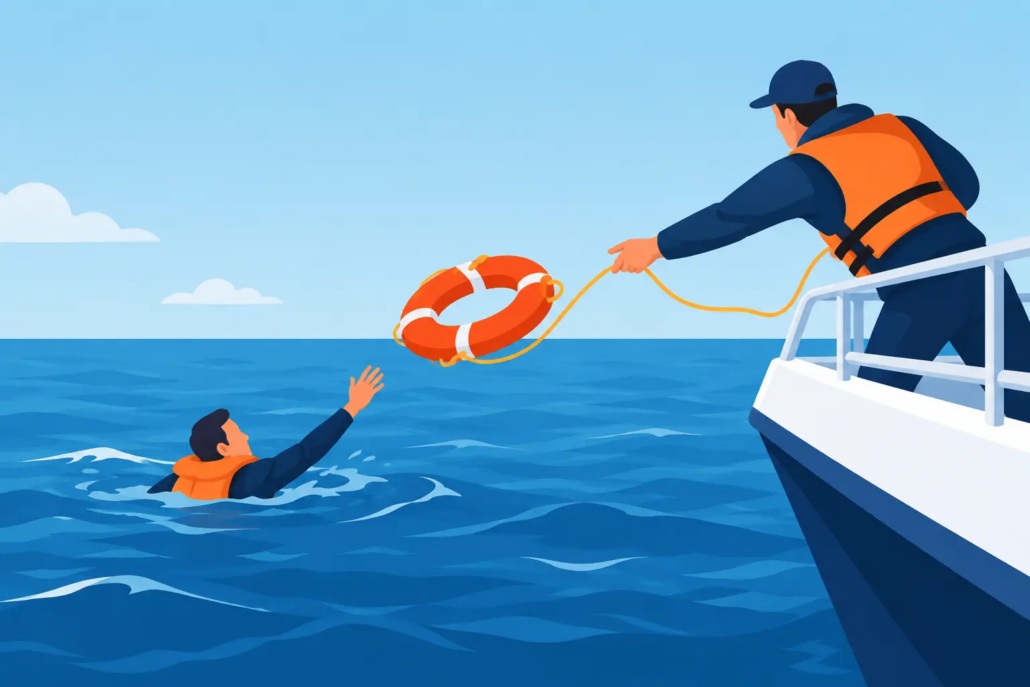
How to Recover Man Overboard Safely at Sea
A person entering the water unexpectedly changes everything on board. Whether you are daysailing off Antigua, running a charter itinerary, or building sea miles toward a professional qualification, the first seconds determine whether the recovery remains controlled. Knowing how to recover man overboard is not about performing a perfect maneuver. It is about protecting the casualty, keeping the crew organized, and bringing the boat back alongside without creating a second emergency.
The traditional call is “Man overboard!” Many crews now use “Person overboard” or simply “MOB,” but the response is the same: shout the alarm, keep visual contact, stop the boat from getting farther away, and begin a practiced recovery plan.
The first actions after a man overboard
The person who sees the casualty go overboard should shout the alarm immediately and continue pointing at them. That continuous point is remarkably effective. In waves, glare, rain, or late-afternoon Caribbean light, a head in the water can disappear from view far faster than most new sailors expect.
At the same time, throw flotation toward the casualty. A lifebuoy, horseshoe buoy, dan buoy, or other buoyant equipment gives them something to hold and provides a visible marker if you temporarily lose sight of them. Do not aim to hit them. Throw beyond them if necessary, allowing wind and waves to carry the equipment closer.
Assign clear roles. One person watches and points. One person prepares recovery equipment. The skipper takes command of the vessel and communicates the plan. If conditions allow, another crew member should make a distress call or prepare navigation equipment. On a crewed yacht, press the MOB function on the GPS or chart plotter as soon as practical. That position can be invaluable if visibility worsens or the vessel has traveled a significant distance before turning back.
If the engine is running, be especially alert to propeller danger. Keep the casualty away from the stern and do not use power carelessly close to someone in the water. A propeller strike can turn a recoverable incident into a critical injury.
Decide whether to sail or motor back
The right recovery technique depends on the vessel, sea state, wind strength, available crew, and how far away the casualty is. There is no single turn that fits every situation. What matters is arriving under control, ideally to leeward of the person, with the vessel stopped or moving very slowly at the moment contact is made.
Recovery under sail
On a sailing yacht, the commonly taught quick-stop method is often the safest default. Immediately tack the boat, then ease sails and position the yacht so it can drift back toward the casualty while remaining maneuverable. Because the boat stays relatively close to the original incident point, the crew retains a better visual reference and avoids a large, fast circle that can make spotting difficult.
A figure-eight or a broad-reach recovery may be appropriate when there is more room and a skilled helm. These methods can give a more deliberate final approach, particularly in stronger breeze. The trade-off is that they involve more distance and more sail handling. A maneuver that looks tidy in a training exercise may be a poor choice if the crew is inexperienced, visibility is low, or the casualty is already tiring.
Approach on a controlled course with enough room to stop before reaching the person. Avoid placing the boat directly upwind of them, where a loss of control could cause the vessel to drift down onto the casualty. Aim to finish to leeward, keeping sails depowered and the side deck clear for the recovery.
Recovery under power
If you choose to use the engine, start it only when the area around the propeller is clear and the casualty is safely away from the stern. A sailing vessel may be easier to control under engine in heavy weather, at night, or when the crew needs both hands free for the recovery. It can also be the right decision when the casualty is unconscious, injured, or unable to assist.
Make the final approach at minimum speed. Come alongside from downwind or down-current where possible, using the boat’s drift to your advantage. Shift to neutral well before reaching the casualty. Never reverse close to a person in the water unless there is no safer alternative and you are certain of their location relative to the propeller.
Bring the casualty alongside safely
Getting back to the person is only half the job. Bringing them aboard can be physically demanding, especially if they are cold, injured, wearing heavy clothing, or unable to climb. A tired casualty may not be able to use a boarding ladder even when it is available.
First establish contact. Pass a throwing line, heaving line, or recovery sling, and encourage the casualty to keep their life jacket on. If they are conscious, speak calmly and give one instruction at a time. “Hold the line.” “Stay on this side.” “We are bringing the ladder down.” Simple direction reduces panic and helps the crew assess whether the person is alert and responsive.
For a conscious, uninjured person, a stern ladder may be practical if the engine is off and the sea state permits. In many cases, recovering over the side near the shrouds is safer because it keeps the casualty clear of the stern. A lifesling, boarding strop, or purpose-built recovery device can support the person while the crew prepares a stronger lift.
An unconscious or injured casualty must be lifted horizontally where possible. Hauling someone vertically by the arms, or relying on a standard life jacket to bear their full weight, risks injury and may be ineffective. Use a halyard, boom lift, recovery strop, or dedicated rescue system that is appropriate for the vessel. Secure the lift point, protect the casualty from swinging against the hull, and use mechanical advantage if needed.
This is where preparation makes the difference. Every regular crew should know where the lifebuoy, heaving line, recovery sling, first-aid kit, blankets, and emergency communications equipment are stored. During training, practice setting up the recovery system before the pressure of a real incident.
Care for the person once aboard
Recovery is not complete when the casualty crosses the rail. Assess them immediately for breathing, responsiveness, bleeding, suspected spinal injury, and signs of cold stress. Even in warm Caribbean water, prolonged immersion, fatigue, swallowing water, and shock can become serious.
Keep the person warm, dry, and protected from wind. Remove wet outer layers only if it can be done safely and replace them with dry clothing or blankets. Give reassurance and monitor them closely. Do not assume that someone who says they are fine is ready to resume sailing.
If they are unresponsive and not breathing normally, begin CPR and follow your vessel’s emergency procedures. Make a distress call when urgent medical support is needed. If they are breathing but have inhaled water, suffered a head strike, appear confused, complain of chest pain, or show worsening fatigue, seek medical assessment without delay. Delayed respiratory complications can occur after a near-drowning event.
Record the time of the incident, position, sea conditions, actions taken, and any treatment given. For commercial operators, charter skippers, and professional crew, accurate reporting is part of sound seamanship and may be required by company procedures or local authorities.
Train until the sequence feels natural
A man overboard recovery is a team exercise, even when there are only two people aboard. The helmsman must control the boat, but everyone needs to understand the sequence: raise the alarm, point, throw flotation, mark the position, return under control, recover, assess, and escalate if necessary.
Practice in varied conditions, not only on flat water with a bright training buoy. Rehearse in stronger breeze, with reduced visibility, and with a crew member assigned to communicate rather than handle lines. Rotate roles so every sailor can take the helm, maintain a visual watch, and prepare the recovery gear. For skippers working toward RYA, commercial, or charter responsibilities, these repetitions build the calm decision-making that standards alone cannot teach.
At Ondeck Sailing, practical safety training is treated as a live seamanship skill, not a box to check. Antigua’s trade winds, clear waters, and active sailing grounds offer an exceptional setting to build confidence, while also reminding crews that good conditions never remove the need for disciplined preparation.
The best man overboard recovery is usually the one nobody has to make. Use life jackets when conditions warrant them, clip on before a situation becomes demanding, maintain secure handholds, and set clear watch routines. But if someone does go overboard, a calm crew with a rehearsed plan can turn a frightening moment into a controlled recovery.
