
Top Safety Courses Yacht Crew Need Before Joining
A smart yacht crew CV is not built on certificates alone. It is built on evidence that you can stay useful when conditions change fast: a fire alarm in the engine room, a man overboard call, a medical incident at anchor, or a security concern during a busy turn-around. The top safety courses yacht crew should prioritize give you a practical foundation for those moments while helping you meet the expectations of captains, management companies, charter operators, and flag-state regulations.
For new crew, the question is rarely whether to take safety training. The real question is which qualifications must come first, which add value for your intended role, and how to choose training that prepares you for life aboard rather than simply filling a line on a CV.
Start With STCW Basic Safety Training
STCW Basic Safety Training is the essential starting point for most crew seeking paid work on commercial yachts. STCW refers to the international standards for training, certification, and watchkeeping for seafarers. While hiring and compliance requirements can vary by yacht, flag, role, and cruising area, Basic Safety Training is widely expected before a crew member steps aboard professionally.
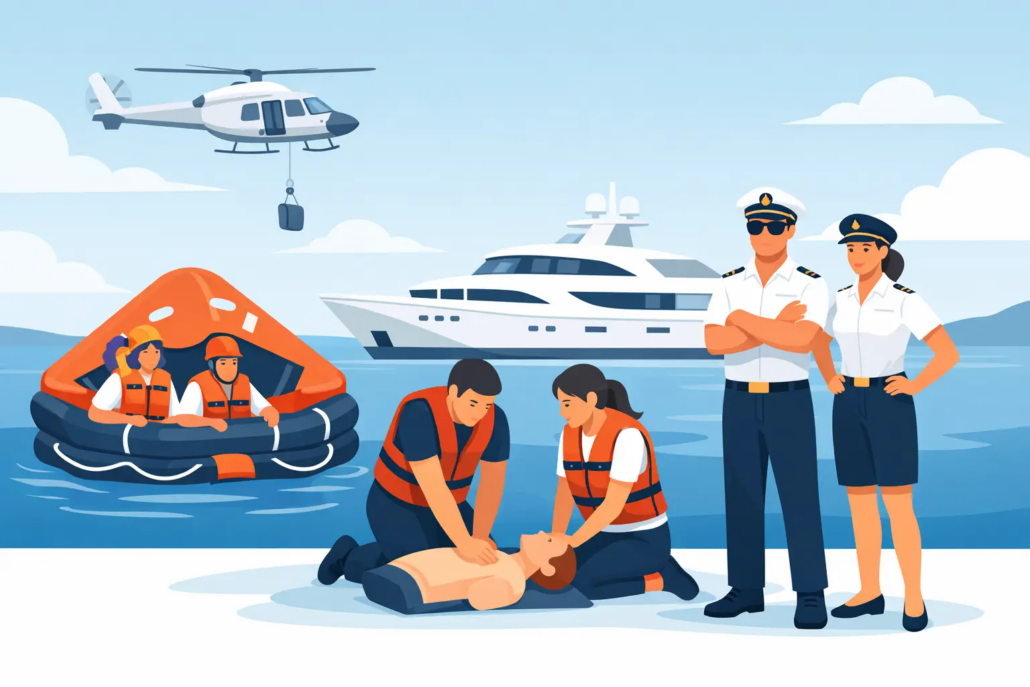
A recognized STCW Basic Safety Training program commonly includes four core elements: personal survival techniques, fire prevention and firefighting, elementary first aid, and personal safety and social responsibilities. Together, they address the basic emergencies that every person on board may face, whether they work on deck, in the interior, in the galley, or in the engine room.
The value is not theoretical. Personal survival training covers abandoning ship, lifejacket use, flotation techniques, and survival priorities in the water. Firefighting teaches crew how fires develop, how extinguishers are selected, and why a fast, disciplined response matters in a confined vessel. First aid gives crew an initial response framework before professional medical support is available. Personal safety focuses on safe working practices, communication, responsibilities, and the human factors that prevent incidents from escalating.
For career-switchers, it can be tempting to treat STCW Basic Safety Training as a quick box to check. Treat it as your first professional standard instead. Captains notice crew who understand why they are being asked to wear protective equipment, report a hazard, secure a tender, or follow an emergency muster plan.
Security Training for Yacht Crew
Security is a routine part of professional yachting, particularly for yachts operating internationally, carrying high-profile guests, or moving through busy ports and marinas. The appropriate course depends on your duties.
Security Awareness training is generally suited to crew who need to recognize security threats, understand security procedures, and report concerns. It introduces subjects such as suspicious activity, restricted areas, access control, and the role of the ship security plan.
Crew who have designated security responsibilities may need more advanced training, often described as Security Duties or Proficiency in Designated Security Duties. This is not automatically necessary for every entry-level crew member. However, it can be a sensible next step when a captain or employer assigns security-related tasks, or when you are progressing toward greater operational responsibility.
The trade-off is simple: do not collect specialist certificates before you have the core training and sea time to use them well. Get the training that matches the job you are pursuing, then build from there.
Sea Survival: Turn Drills Into Real Confidence
STCW personal survival techniques are fundamental, but dedicated sea survival training can add a highly relevant layer for sailors and yacht crew. A practical sea survival course places emphasis on the decisions that follow an abandonment or serious emergency: when to leave the vessel, how to manage a life raft, how to improve visibility, how to ration resources, and how to work as a group under pressure.
This is especially valuable for crew working on sailing yachts, charter vessels, or programs that operate offshore between islands. Caribbean conditions can be spectacular, but warm water does not eliminate risk. Strong squalls, night passages, equipment failures, and changing sea states demand calm, practiced responses.
An RYA Sea Survival course can be a strong choice for sailors who want hands-on familiarity with life rafts and survival equipment. It complements rather than replaces any commercial safety qualification an employer requires. Ask yourself where you want to work: a large motor yacht, a sailing yacht, a day-charter operation, or a private cruising program may each place different weight on particular training.
First Aid Beyond the Basics
Elementary first aid is included in Basic Safety Training, but it is exactly that: elementary. On a yacht, the nearest clinic may be several hours away, the crew may be managing a guest in pain, and communications may be limited. Further first aid training can be a practical investment for senior deckhands, stews with guest-facing responsibilities, skippers, and anyone working aboard vessels that cruise farther from shore.
Look for training that develops assessment, casualty management, CPR, bleeding control, burns, fractures, environmental illness, and communication with shore-based medical services. The best program for you depends on the vessel’s operation and the medical responsibilities you may be asked to carry. A day-charter crew member operating close to Antigua may need a different level of preparation than a crew member crossing to the Grenadines or joining an offshore delivery.
Medical training does not make you a doctor. It gives you a method: protect the scene, assess the casualty, call for help, provide appropriate care, monitor changes, and record what happened. That method is invaluable aboard.
Firefighting Training for Higher Responsibility
Every crew member should understand their role in a fire emergency. As you move toward leadership positions, advanced firefighting training becomes increasingly relevant. This is particularly true for crew with watchkeeping duties, senior deck roles, engineering responsibilities, or aspirations to become a skipper or officer.
Advanced fire training goes beyond selecting an extinguisher. It addresses command, team coordination, breathing apparatus procedures, search techniques, boundary cooling, and managing a fire response without creating new risks. A yacht fire can develop quickly because of fuel, electrical systems, machinery spaces, galley equipment, and enclosed accommodation areas. Prevention remains the best defense, which is why good crew habits matter so much: clean work areas, correct storage, equipment checks, and prompt reporting of faults.
Before enrolling, confirm whether the course is accepted for the certification pathway or flag requirements relevant to your career. A course can be excellent training yet not satisfy a specific compliance requirement.
Supporting Qualifications That Make Safer Crew
Not every valuable safety qualification has “safety” in its title. The strongest crew combine formal emergency training with everyday operational competence.
An RYA Powerboat Level 2 course, for example, helps crew handle tenders more safely through practical work on maneuvering, launching considerations, close-quarters control, and decision-making. An SRC VHF radio course improves your ability to communicate clearly during routine operations and an emergency. Navigation, radar, and passage-planning courses help reduce the chance of an emergency developing in the first place.
For aspiring skippers, RYA practical training and Yachtmaster progression build the seamanship behind safe command. You learn to assess weather, manage crew, plan passages, respond to equipment issues, and make conservative calls when the conditions do not match the plan. No certificate replaces judgment, but good training gives judgment a stronger base.
Choosing the Right Course Sequence
If you are entering professional yachting, begin with STCW Basic Safety Training and the medical fitness documentation required for your intended employment. Add security training according to the duties you expect to hold. Then choose supporting courses that fit your department and direction: tender and navigation skills for deck crew, enhanced first aid for guest-facing roles, or advanced firefighting and command-focused training as you progress.
Avoid choosing solely on price or convenience. Check that the provider is approved for the qualification being issued, that practical elements are genuinely practical, and that the course is recognized where you plan to work. Training in Antigua offers an added advantage: you can develop these skills in a serious maritime environment surrounded by working yachts, active charter operations, and exceptional sailing grounds.
At Ondeck Sailing, professional safety and maritime training can sit alongside practical RYA progression, helping crew build a pathway that is credible on paper and useful on the water.
Build a Safety Mindset, Not Just a Certificate Folder
The best-trained yacht crew are not the people who talk most about their qualifications. They are the ones who check the tender fuel before departure, know where the nearest extinguisher is, ask when a procedure is unclear, and remain composed when a guest needs help. Courses give you the framework. Repetition, good mentorship, and real seamanship turn that framework into dependable action.
Choose your next safety course with the job ahead in mind, then arrive ready to learn, practice, and contribute. On a yacht, that confidence protects your crew, your guests, and the freedom to keep exploring remarkable waters safely.

