
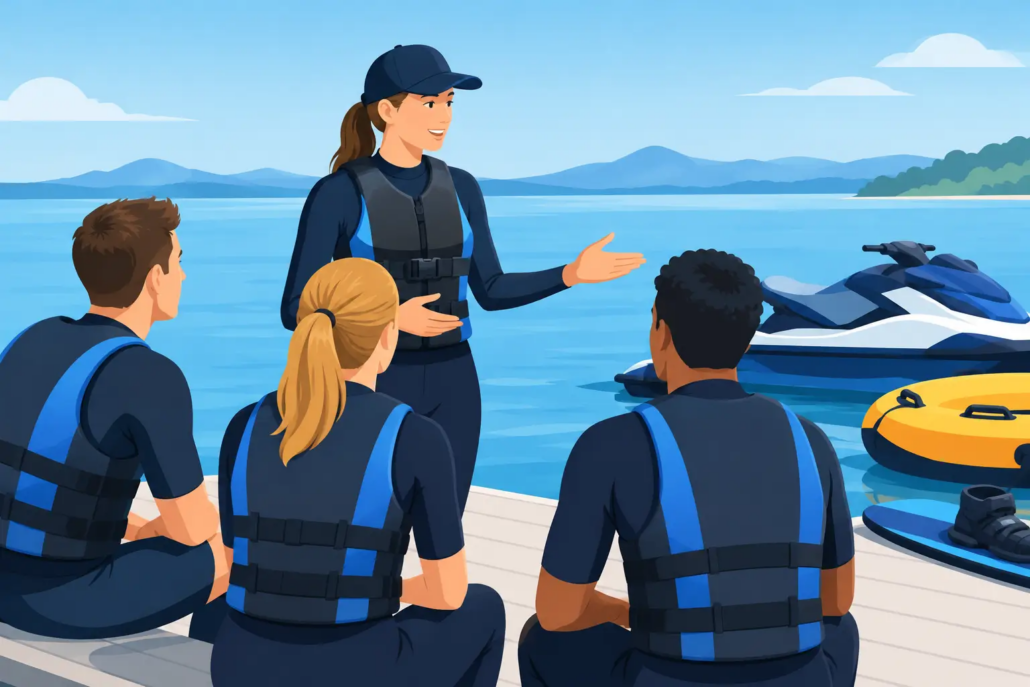
Watersports Staff Training That Builds Safer Teams
A guest is drifting beyond the marked swim area. A sudden squall is rolling across the bay. A beginner has fallen from a paddleboard and is embarrassed, cold, and unsure what to do next. These are the moments when watersports staff training proves its value. Equipment matters, but capable people make the operation safe, calm, and memorable.
For resorts, charter companies, beach clubs, marinas, and activity operators, training should do more than satisfy a checklist. It should give every team member the judgment to read conditions, protect guests, communicate clearly, and know when an activity needs to pause. In the Caribbean, where warm water and trade winds invite guests outside every day, that level of readiness protects both your reputation and your people.
What Effective Watersports Staff Training Covers
A capable watersports team needs a shared operating standard. The exact program depends on the activities you offer, the size of your fleet, local regulations, and the experience of your guests. A sailing center with dinghies and catamarans has different risk points from a resort running kayaks, snorkeling trips, personal watercraft, and towable activities.
The foundation, however, remains consistent: staff must understand the environment, the equipment, the customer, and their responsibilities within the operation. Training is strongest when it combines recognized maritime safety standards with drills based on the actual beach, boats, weather patterns, and guest profile your team handles.
Safety and emergency response
Every staff member should be able to identify hazards before an incident develops. That includes changing wind and sea state, currents, lightning risk, vessel traffic, fatigue, poor equipment condition, and guests whose confidence exceeds their ability.
Practical emergency training should cover recovery from the water, use of rescue equipment, radio procedures, incident communication, first aid awareness, and decision-making under pressure. Staff do not need to respond to every situation in the same way. A minor cut, a missing child, an approaching squall, and a capsized dinghy each require different actions, different communications, and a clear chain of command.
MCA/STCW-aligned safety and security training can be particularly valuable for teams working around commercial vessels, charter yachts, transport operations, or larger marine facilities. It gives staff a recognized framework while reinforcing the habits that prevent small problems from escalating.
Technical competence on the water
Guests quickly notice whether an instructor or beach attendant is genuinely at ease around boats. Staff should be able to rig, launch, recover, and inspect the equipment they supervise. They need to demonstrate correct technique, explain it in plain language, and adapt their coaching for a nervous first-timer or a confident returning guest.
For sailing operations, this may include boat handling, sail trim, capsize recovery, towing, anchoring, collision avoidance, and basic navigation. For paddlesports, it may mean board and kayak fitting, leash use, group control, self-rescue, and route selection. Motorized operations need a strong focus on pre-departure checks, maneuvering, lookout, speed management, and safe guest briefings.
Recognized RYA practical and theory pathways can help build this competence in a structured progression. The right level depends on the role. A team member assisting guests from shore may need strong rescue and briefing skills, while a supervisor taking vessels offshore needs greater navigational, operational, and leadership capability.
Guest care and clear instruction
Great watersports staff are not only technically qualified. They are observant hosts. They spot the guest who nods during the briefing but has not understood it. They can manage a mixed-age family without making anyone feel rushed. They set boundaries without sounding dismissive.
A good briefing is short, specific, and repeatable. It tells guests what they are doing, where they can go, what to do if they need help, and when to return. It also gives them permission to stop. Guests are more likely to speak up about fatigue, seasickness, anxiety, or a poor fit when staff create an atmosphere of calm professionalism.
This service skill matters commercially as well. Confident, well-cared-for guests stay longer, try new activities, recommend the experience, and return for more advanced instruction.
Train for Your Operation, Not a Generic Checklist
Off-the-shelf courses are valuable, but they are only one part of a useful training program. The most effective watersports staff training also addresses the conditions your team meets every week.
Start with a simple operational review. Where do guests enter and exit the water? What happens when wind shifts offshore? Which areas are shared with swimmers, charter boats, fishing vessels, or cruise-ship tenders? How are weather decisions communicated? Where is emergency equipment stored, and can every team member access it quickly?
Then build scenarios around real pressure points. If your team works in Antigua, for example, they should practice responding to the gusts, sea conditions, and busy anchorages that are part of the local sailing environment. A drill conducted from the actual dock or beach reveals issues that a classroom exercise cannot: unclear radio channels, a missing throw line, an uncertain handover, or a rescue craft that is not ready to launch.
Bespoke training is especially worthwhile for businesses offering several activities. A resort may need one shared safety culture, while the sailing, snorkeling, and motorboat teams need role-specific practical sessions. This avoids the common mistake of assuming that a strong sailor automatically understands paddleboard supervision, or that an experienced beach attendant is prepared to manage a vessel emergency.
Build Progression Into Every Role
Training should not end with an induction day. New staff need a clear route from supervised assistant to trusted instructor, skipper, or operations lead. That progression improves retention because ambitious people can see a future in the business rather than a seasonal job with no next step.
A practical pathway may begin with site orientation, equipment checks, guest briefings, and supervised rescue drills. From there, staff can move into formal first aid and safety training, RYA sailing or powerboat qualifications, navigation theory, and commercial licensing where their responsibilities require it. Experienced team members can progress toward advanced skippering, Yachtmaster-level competence, or regional credentials such as a Caribbean Boatmaster qualification.
Not every employee needs every certificate. Overtraining can be expensive and can pull staff away from operations without improving the role they actually perform. The better approach is to map qualifications to responsibility, then keep a record of who is authorized to supervise, instruct, drive, rescue, or make a weather-related operational call.
Assess Competence Where It Counts
Certificates demonstrate that a person has met a course standard. They do not automatically confirm that the person can perform confidently in your specific operation six months later. Assessment should therefore include observation on the job.
Watch how staff prepare equipment before a busy morning. Listen to a guest briefing. Ask them to explain what they would do if visibility drops, a guest becomes separated from the group, or a boat returns with a mechanical issue. Run drills at different times and in different conditions, not only when the sea is flat and the team expects the exercise.
Keep feedback direct and useful. If a staff member needs to improve radio discipline, rescue positioning, or the pace of their instruction, show them what good looks like and give them a chance to repeat it. The goal is not to catch people out. It is to make correct actions instinctive before a genuine emergency demands them.
The Business Case Is Bigger Than Compliance
A trained team reduces preventable incidents, equipment damage, canceled activities, and difficult guest conversations. It also gives managers more confidence to delegate, particularly during busy holiday periods when multiple activities may be running at once.
There is a brand benefit, too. Guests may not know the names of every qualification, but they recognize organized launches, well-maintained gear, clear briefings, and staff who respond without panic. Those details turn an afternoon on the water into an experience people trust enough to recommend.
For maritime businesses, professional development also supports recruitment. Crew and instructors are more likely to join and stay with an employer that invests in credible training and offers a real route toward greater responsibility. Ondeck Sailing can shape training around those operational needs, from foundational safety through practical sailing, powerboat, and commercial progression.
The best time to test a team is not after the wind rises or the guest is already in difficulty. Give your staff the skills, practice, and authority to act early, and they will create the kind of safe Caribbean experience that guests remember for all the right reasons.

